
Why Natural Toys Matter - And What I Learned as a Mom

Updated: Jul 22

Why Natural Toys Encourage Imagination
When my son was little, I bought him every toy that lit up, moved or made noise.
Like many parents, I thought the more exciting a toy looked, the more he would enjoy it.
But a few years later, I noticed something surprising: the toys he kept returning to were usually the quietest and simplest ones - a wooden animal, a soft doll, a small car, a ball or a set of building pieces.
That changed the way I looked at play.
Natural toys made from wood, felt, cotton and other carefully chosen materials are not simply beautiful objects. They offer children something many modern toys do not: space. Space to imagine, experiment, create stories and decide for themselves what happens next.
Simple Toys Leave Room for Imagination
Many electronic toys are designed to entertain children immediately. They flash, sing, speak or move at the press of a button. They can capture attention quickly, but they often decide the direction of play for the child.
A simple toy works differently.
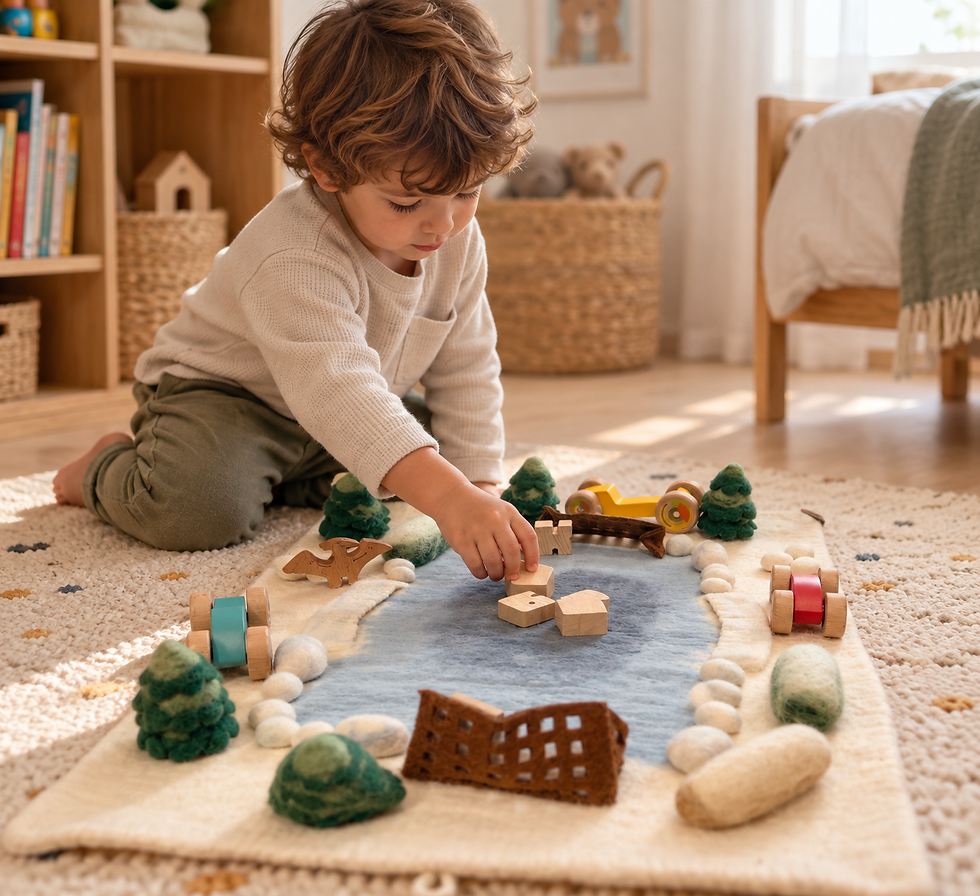
A wooden block can become a house, a bridge, a bed, a shop counter or part of an imaginary world. A felt animal can be a character in a story, a friend on an adventure or part of a farm, forest or jungle.
The toy does not tell the child what to do. The child gives the toy meaning.
This type of open-ended play encourages children to make decisions, solve small problems and develop their own ideas. The same toy can be used differently every day, depending on the child’s age, mood and imagination.
Natural Materials Offer a Rich Sensory Experience
Children explore the world through their senses. They notice weight, texture, temperature, shape and movement.
Natural materials provide subtle sensory differences. Wood feels firm and warm.
Wool felt is soft and textured. Cotton dolls are comforting to hold. These materials feel very different from smooth, lightweight plastic.
This does not mean every plastic toy is bad, but natural materials can create a calmer and more grounded play experience. Their textures and small imperfections also help children understand that objects do not all need to look or feel exactly the same.
Handcrafted toys often carry signs of the maker’s work. Slight variations in shape, grain or stitching make each piece feel more individual and special.
Children Often Play Longer with Less
One of the biggest lessons I learned as a mother was that more toys do not always lead to more play.
When children are surrounded by too many options, they may move quickly from one toy to another without becoming deeply involved in any of them. A smaller, thoughtfully chosen collection can make it easier for children to concentrate and develop a story.
Natural toys are often designed without one fixed purpose. This allows play to continue and change instead of ending once a button has been pressed or a single activity has been completed.
A child may first use wooden animals to practice names and sounds. Later, those same animals may become part of a long imaginary game. As the child grows, the story becomes more detailed, but the toy remains relevant.
They Encourage Connection
Simple toys can also create opportunities for children and adults to play together.
Because there is no recorded voice or fixed set of instructions controlling the game, children naturally invite others into their world. A parent can become a character, help build a scene, ask questions or simply listen as the child explains what is happening.
These moments of shared play support language, confidence and emotional connection.
They also allow parents to observe their child more closely. Through imaginary play, children often express ideas, worries and experiences that they may not explain directly in conversation.
Quality Matters More Than Quantity
Natural toys are often chosen for their durability as well as their appearance.
A well-made wooden toy or felt play set can be enjoyed for years, shared between siblings and sometimes passed on to another family. This makes it different from a toy that is quickly broken, forgotten or replaced.
Buying fewer, better-quality toys can also teach children to value and care for their belongings.
At Tommy Luv, we do not believe that a child needs a perfectly styled playroom or an enormous toy collection. We believe that carefully selected toys can offer more meaningful play than shelves filled with items that are rarely used.
What I Look for When Choosing a Toy
Today, I ask different questions before choosing a toy.
Can the child use it in more than one way? Does it invite imagination? Does it feel pleasant and satisfying to hold? Is it made with care? Can it remain interesting as the child grows? Is it something the family will want to keep?
The most beautiful toy is not always the most colorful or complicated one. Sometimes it is the toy that waits quietly for the child to bring it to life.
A More Thoughtful Kind of Play
Natural toys taught me that children do not need constant entertainment. They need time, freedom and materials that allow their own ideas to develop.
A simple wooden toy, a soft felt character or a handmade doll may not perform for the child. Instead, it invites the child to participate.
And that is where meaningful play begins.
At Tommy Luv, every item is selected with this idea in mind: toys should respect the child, encourage creativity and become part of the small, joyful moments that shape childhood.


Comments