
“Mum, I’m Bored!” – Independent Play for Children

Why Boredom Can Actually Be a Wonderful Thing for Children
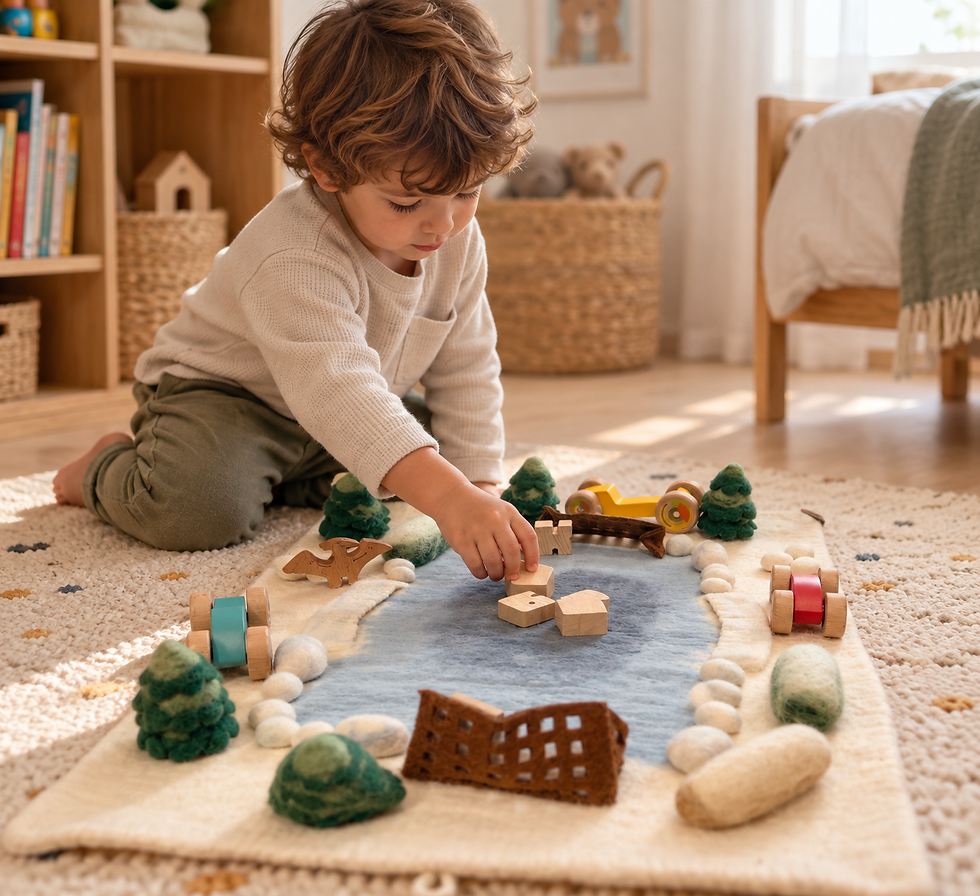
“Mum, I’m bored.”
It is one of those sentences parents hear again and again - and often, our first instinct is to solve the problem immediately.
We suggest an activity, a game, some arts and crafts, television, or a tablet. We look for something that will entertain them, keep them happy, and fill that empty moment when they simply do not know what to do.
But what if that moment is actually important?
What if boredom is not a problem we need to fix, but a space children need to learn how to fill for themselves?
Why Independent Play for Children Matters
Children today are surrounded by stimulation.
Screens, videos, apps, activities, classes, and toys that light up, make sounds, give instructions, and tell children exactly what to do next.
When children become used to something outside of themselves always providing the next source of entertainment, it can become harder to stop and ask:
“What do I want to do now?”
Free play gives children the opportunity to find that answer for themselves.
Independent play for children is an important part of developing creativity, confidence and imagination.
Boredom is often where imagination begins
Imagine a bowl of pretend fruit, a few wooden blocks, a doll, or some small animals.
There are no instructions.
No screen.
No first step, second step, or final goal.
And then something starts to happen.
The fruit becomes a shop.
Then a restaurant.
The wooden blocks become a house, a bridge, or a castle.
The doll goes on an adventure.
The animals create an entire forest in the middle of the living room.
That is the beauty of open-ended play: the child is not simply using the toy - the child is creating the game.
“But my child always asks me to play”
That is completely natural.
Children love playing with us, and that shared time is important.
But alongside playing together, there is also real value in a child learning how to become absorbed in play independently.
Independent play does not mean leaving a child alone for hours.
It can begin with just ten minutes.
You can sit nearby, do something of your own, and remain present without directing the play.
When your child asks:
“What should I do?”
Sometimes, instead of giving an answer, you can ask:
“What do you think you could do with this?”
That small question gently puts the play back into their hands.
Fewer toys can sometimes mean more play
It is easy to assume that a bored child simply needs more things.
But sometimes the opposite is true.
When too many toys are available at once, choosing can become difficult. Children may move quickly from one toy to another without becoming deeply engaged in any of them.
Try leaving out fewer toys at a time.
A few animals.
Some blocks.
A small play kitchen with pretend food.
Dolls.
Cars.
Scarves or pieces of fabric.
Then rotate them from time to time.
A toy that has been away in a cupboard for a month can suddenly feel new again.
A good toy does not need to do very much
Sometimes, the toy that does the least allows the child to do the most.
An open-ended toy does not tell the child what the story is.
It leaves the story to the child.
A wooden block can be a car today and a house tomorrow.
A piece of felt can become food, a forest, the sea, or a blanket for a doll.
The same toy can take on a completely different meaning at different ages and in different games.
That is one of the reasons children often return again and again to simple, well-made toys - they grow with them.
And what about screens?
The goal does not have to be a completely screen-free home.
Screens are part of modern life, and they can be useful and enjoyable.
But there is a difference between choosing to watch something and automatically reaching for a screen every time boredom appears.
Not every quiet moment needs to be filled immediately.
Children also need opportunities to look around, think, experiment, feel a little bored - and then invent something.
The next time you hear “I’m bored”
You may not need to rush in and solve it.
You can smile and say:
“I’m sure you’ll think of something.”
Then give it a moment.
It may take a few minutes.
There may be some complaints.
But sometimes, after that, the magic begins.
A story appears.
A little world is built.
An idea is born that was not there before.
And that is where children learn something no app can truly give them:
how to create something from within themselves.
At Tommy Luv, we love toys that leave space for imagination.
Wooden toys, felt toys, and natural materials that do not tell children exactly how to play, but invite them to explore, create, and build worlds of their own.
Because sometimes the very best play begins with the words:
“Mum, I’m bored.”


Comments